Field Guide EP 13
Multi-store rollout: templates, localisation and approvals
Season 1, Episode 13 of the retail screen field guide. One flagship can run on care and late nights. Forty stores in three countries cannot. Scale is templates, approvals and versions, plus one thing most networks forget: room for each store to speak in its own voice.
Watch the episodePDF: Rollout Standard
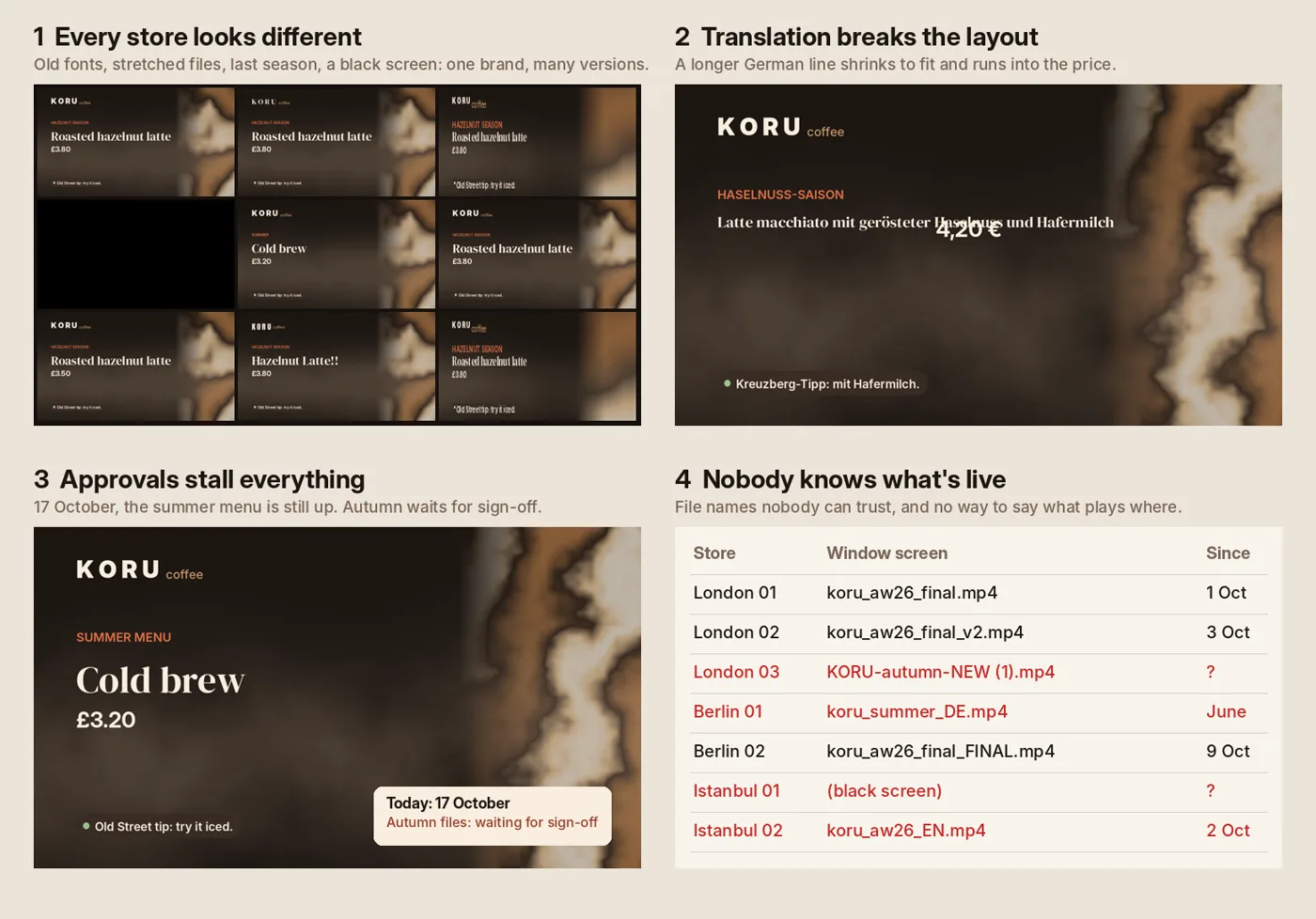
The first of October, head office of a coffee chain with forty branches in London, Berlin and Istanbul. The autumn campaign goes live today. By lunchtime, a store manager in Berlin has sent a photo: the German headline was too long, so the player shrank it until it fit, and now it runs straight into the price. Istanbul is still showing the English file. One London branch is playing something called "KORU-autumn-NEW (1).mp4" that nobody remembers approving. Two other stores are still on the summer menu, because their files were waiting for a sign-off that never came.
And the stores that did get it right all say exactly the same thing, in exactly the same words, as if no one who works there had ever seen the neighbourhood.
The principle: a central spine and a local voice
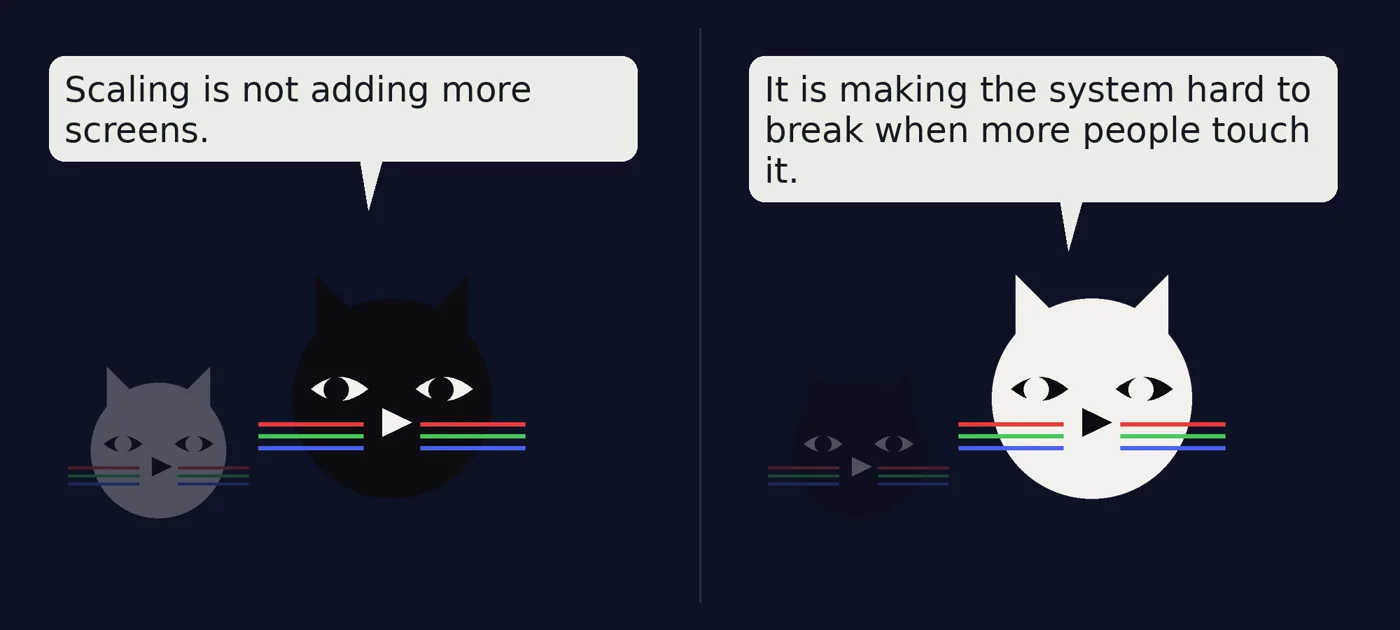
With one store, heroics work: a late edit, a manual export, someone watching the screen. With twenty stores, heroics become the problem. Every extra store adds a screen size, a light condition, a language, a currency, a player, a manager, a deadline. The system has to stay consistent while more and more people touch it.
The four rollout failures we see most often in real networks:
- Every store looks different. Old fonts, stretched files, last season's loop, a black screen. One brand, many versions.
- Translation breaks the layout. A longer line in another language shrinks to fit or runs into the price, and the hierarchy collapses.
- Approvals stall everything. Nobody owns sign-off, so campaigns go live late, or never.
- Nobody knows what is live. File names nobody trusts, no register, no rollback.
There is a fifth, and it goes the other way: too much centre. Many networks fix the chaos by making every store say exactly the same thing in the same words. It is consistent, and it wastes the one thing a local store has that head office does not: it knows the street outside. In our view the best networks lock the spine and leave a small, controlled space for local touches, inside the campaigns as well as in the opening hours.
So the rule for this episode: lock the spine, fill the fields, give the store one line.
The mechanism: templates, elastic copy, approvals, versions
1. Templates with three kinds of zone. A template is governance written into a design. Each one has:
- Locked zones, never edited in a store: the ground and its motion, the grid, type sizes and weights, colours, the marker, the safe area. This is the brand's spine.
- Fields, filled per country and approved centrally: headline, support line, product media, price, dates.
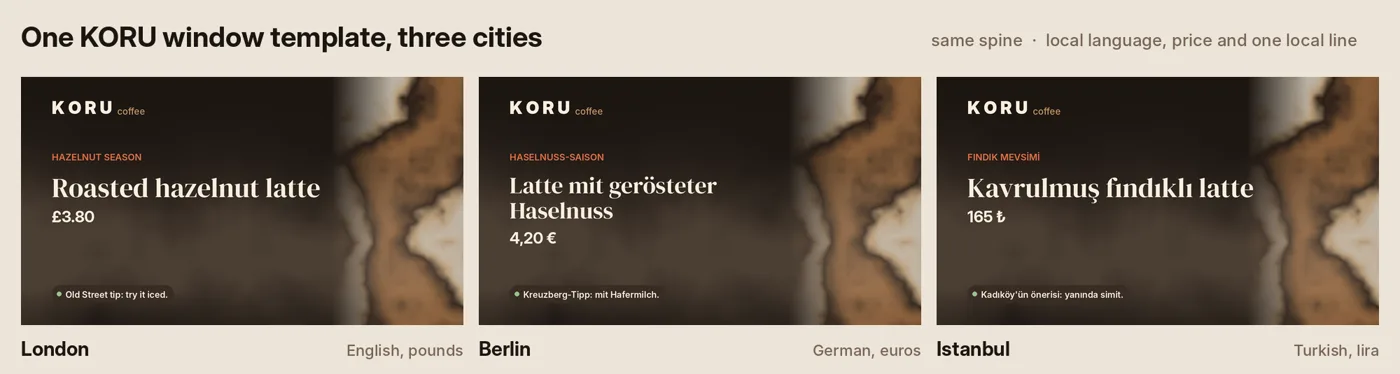
- A local touch, one line written by the store, in a fixed slot, capped in length and always dated. KORU's slot holds 40 characters: "Old Street tip: try it iced." "Kreuzberg-Tipp: mit Hafermilch." "Kadıköy'ün önerisi: yanında simit." (Kadıköy's suggestion: have it with a simit.) The campaign is the same; each store makes it sound like that street.
You do not need a hundred templates. Five, mapped to the zones from earlier episodes, run most networks: a window statement, an interior ambient loop, a product highlight, a corner with two faces, and a calm service template for checkout and queues. And one test for all of them: if a template breaks when someone fills it in, it was not a template.
2. Elastic copy, decided in advance. Translation makes text longer, and short text grows the most. IBM's globalisation guidance, summarised by the W3C, tells designers to allow 80 to 100 percent more space for an English string of 11 to 20 characters, so the translation can end up nearly twice as long; text over 70 characters needs about 30 percent more. German also builds long compound words that do not wrap. KORU's headline goes from 22 characters in English to 30 in German, 36 percent longer and well inside that allowance.
So the template decides, not the player and not the store:
- A maximum length per field, and a maximum of two lines.
- When a line will not fit, switch to a second layout state with two lines and a defined smaller step, and never shrink below a floor.
- Write the price format down per country: £3.80, 4,20 €, 165 ₺.
- Test the longest language first.
3. Approvals in two tiers, with numbers. Approvals stall when everything is approved the same way. Split them:
- System approval, rare: templates, motion rules, safe areas, type. Once these are signed off, most of the arguing is over.
- Content approval, frequent and fast: only the fields, inside templates that cannot break.
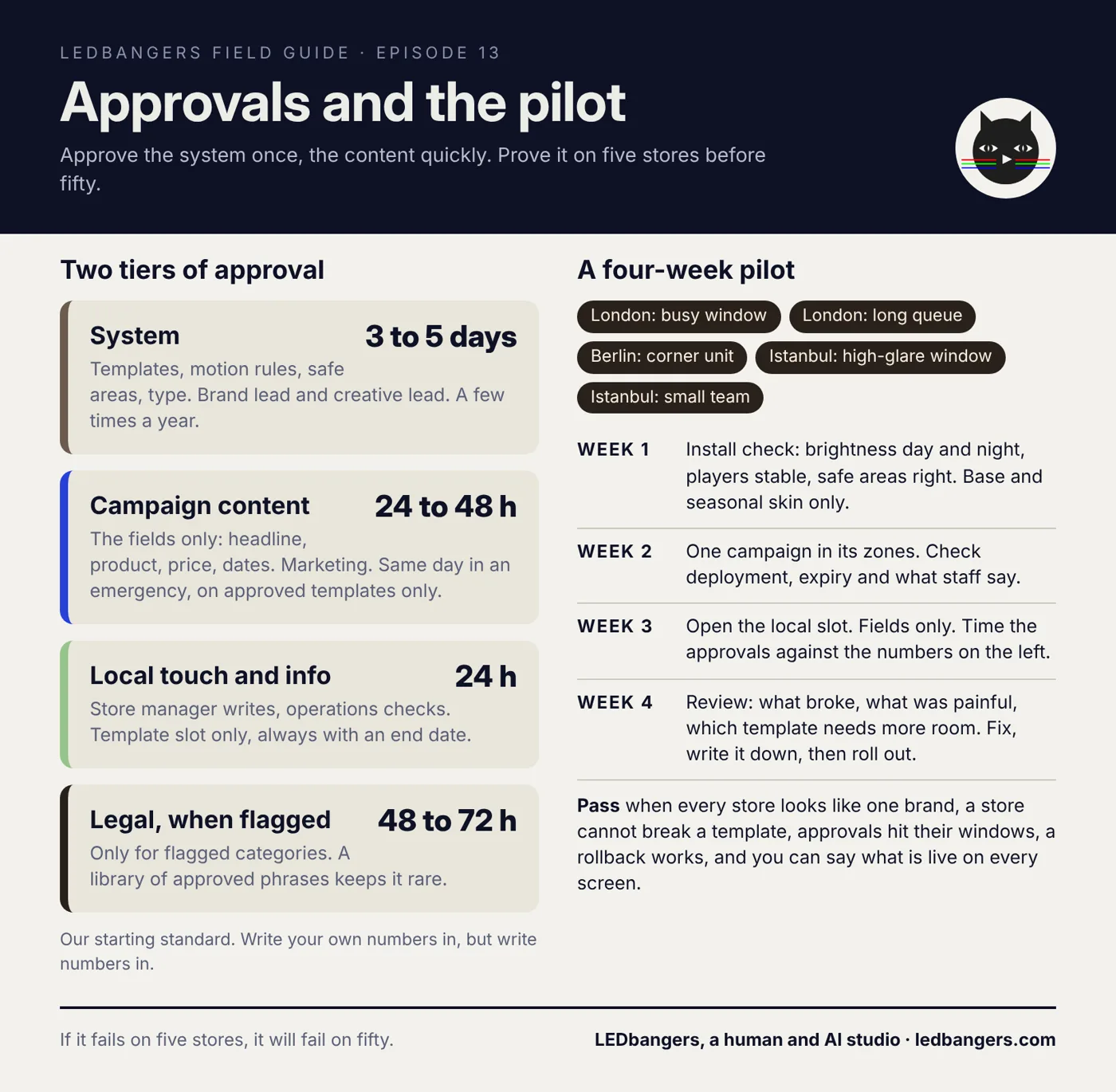
Then put a time window on each: our starting standard is three to five working days for system changes, 24 to 48 hours for campaign fields, 24 hours for local lines, and 48 to 72 hours for legal, only when a category is flagged. Your numbers can differ. What matters is that there are numbers. The out-of-home industry went the same way: in 2024 the US trade body OAAA added human approval of content before it goes live on digital displays to its security guidelines.
4. Versions you can trust. At any moment, someone should be able to say what is playing on every screen, since when, in which version, and who approved it. One naming rule does most of the work: brand, zone, template, campaign, language, version and date, as in KORU_WINDOW_STATEMENT_AW26_DE_V003_2026-10-01. Add a register of what is live where, an end date on every campaign and local item (Episode 12), and a rollback to the last approved set that takes minutes. The in-store retail media standards published by IAB Europe and IAB in December 2024 ask networks to report what actually played; a brand network deserves the same record.
The pilot: five stores before fifty
Do not roll out to every store at once. Pick three to five stores that cover different conditions: a busy window, a long queue, a corner unit, a high-glare window, a store with a small team. Then run four weeks.
- Week 1: check the install. Brightness by day and night, stable players, correct safe areas. Run only the base and the seasonal skin.
- Week 2: one campaign, in its zones. Check deployment, expiry and what staff say.
- Week 3: open the local slot, fields only. Time the approvals against their windows.
- Week 4: review what broke and what was painful, fix the templates, write the steps down. Then roll out.
The pilot passes when every store looks like one brand, no store can break a template, approvals hit their windows, a rollback works, and you can say what is live on every screen. If it fails on five stores, it will fail on fifty.
Seeing it: two mass-market apparel networks
As in every episode: we do not have audience data and we do not fake it. This time the examples are public ones from mass-market fashion, both from case studies published by the signage vendors, so read them as marketing documents: they describe the setup, not sales results.
Benetton. In a case study its vendor, M-Cube, published around 2018, Benetton's in-store screens ran in 180 stores across 18 countries, with displays in the collection areas and behind every checkout. Content was managed centrally and broadcast in 20 languages, with a metadata system linking photos and videos to languages and catalogues. Programming followed the season, the time of day and promotions, while marketing planned campaigns tailored to individual stores. The company's global digital signage manager was quoted saying that he could manage it single-handedly. That is the central spine at work: structure first, so one person can run a network.
Etam. The French lingerie and apparel group's case study, from the vendor Cenareo, describes displays of different sizes in different shops, with each campaign adapted to every size, and content that could respond to local conditions: on the same day, a shop in rainy Brest could promote warmer outfits while one in sunny Marseille showed swimwear. The time to fix a technical problem fell, they say, from a week to a day. That is the local voice, inside the same system.
Neither example proves that screens sell more. Together they show the shape this episode argues for: one structure, many languages and sizes, and space for the store's own conditions.
The deliverable: the Rollout Standard
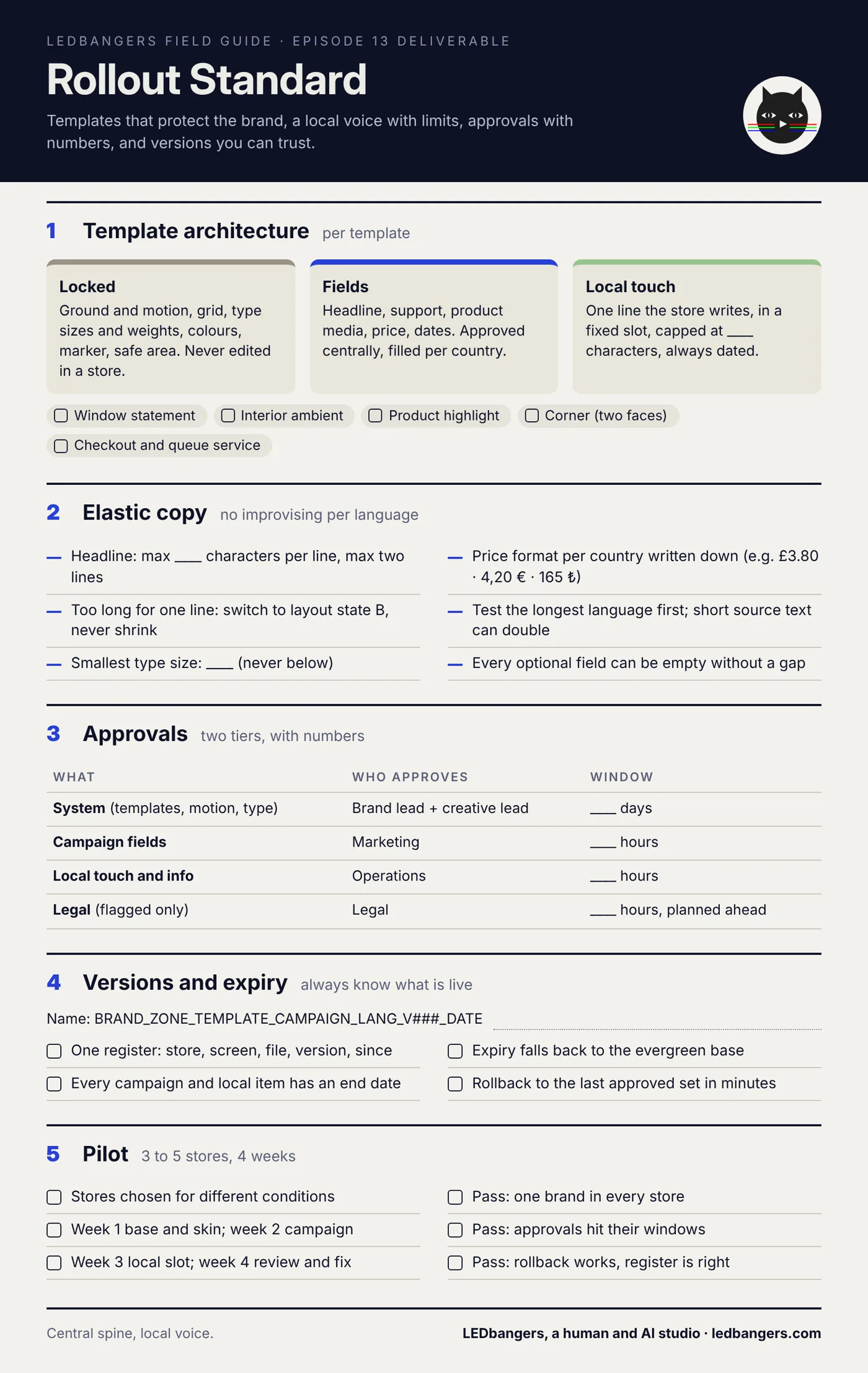
This episode's sheet is the standard for a network on one page: the three kinds of template zone, the elastic copy rules, the approval tiers with blanks for your time windows, versions and expiry, and the pilot with its pass criteria.
The blank sheet is below. Fill it in before the pilot, not after. If you want templates built so that forty stores can fill them in without breaking them, start a brief at ledbangers.com.
One thing to keep
A network scales on templates that protect the brand, approvals with numbers, and versions you can trust, and it stays alive when each store has one line of its own.
The first run, in one list
This episode closes the first run of the field guide:
- Hello, world: who we are and how we work.
- What in-store LED screens are actually for.
- The 5-second rule: how people read screens while walking.
- Loop design: why seamless beats viral.
- Brand consistency on screens: guidelines as motion rules.
- Screen zones: the window and the interior have different jobs.
- Corner screens: one screen, two paths, seen twice.
- Checkout screens: help at the till, not pressure.
- Queue screens: calm, trust and the next step.
- Choosing the right screen: brightness, pixel pitch and distance.
- Aspect ratios: compose, don't crop.
- Content scheduling that doesn't collapse.
- Multi-store rollout: templates, localisation and approvals.
If you want to hear what comes next, follow LEDbangers. If you are planning a rollout, start a brief at ledbangers.com.
LEDbangers is a human and AI studio making code-first motion for retail LED and OLED screens. This episode was researched and written with AI, built on our own research base and on interviews with Burcin Inan Ozel, who reviewed and edited every line. The figures are made in the studio the same way. Poma and Luma are the two cats who argue in the margins: instinct and structure, the two halves of every good screen.
Sources: text expansion in translation, W3C, Text size in translation, after IBM's globalisation guidelines; human approval of digital content, OAAA guidelines, 2024; in-store retail media standards, IAB Europe and IAB, December 2024; Benetton, M-Cube case study; Etam, Cenareo case study.