Field Guide EP 12
Content scheduling that doesn't collapse: a simple monthly system
Season 1, Episode 12 of the retail screen field guide. Most screen networks do not fail because the visuals are bad. They fail because updating them turns into a scramble. A system beats a scramble: four layers, one monthly rhythm, and an end date on everything.
Watch the episodePDF: Layer Model monthly plan
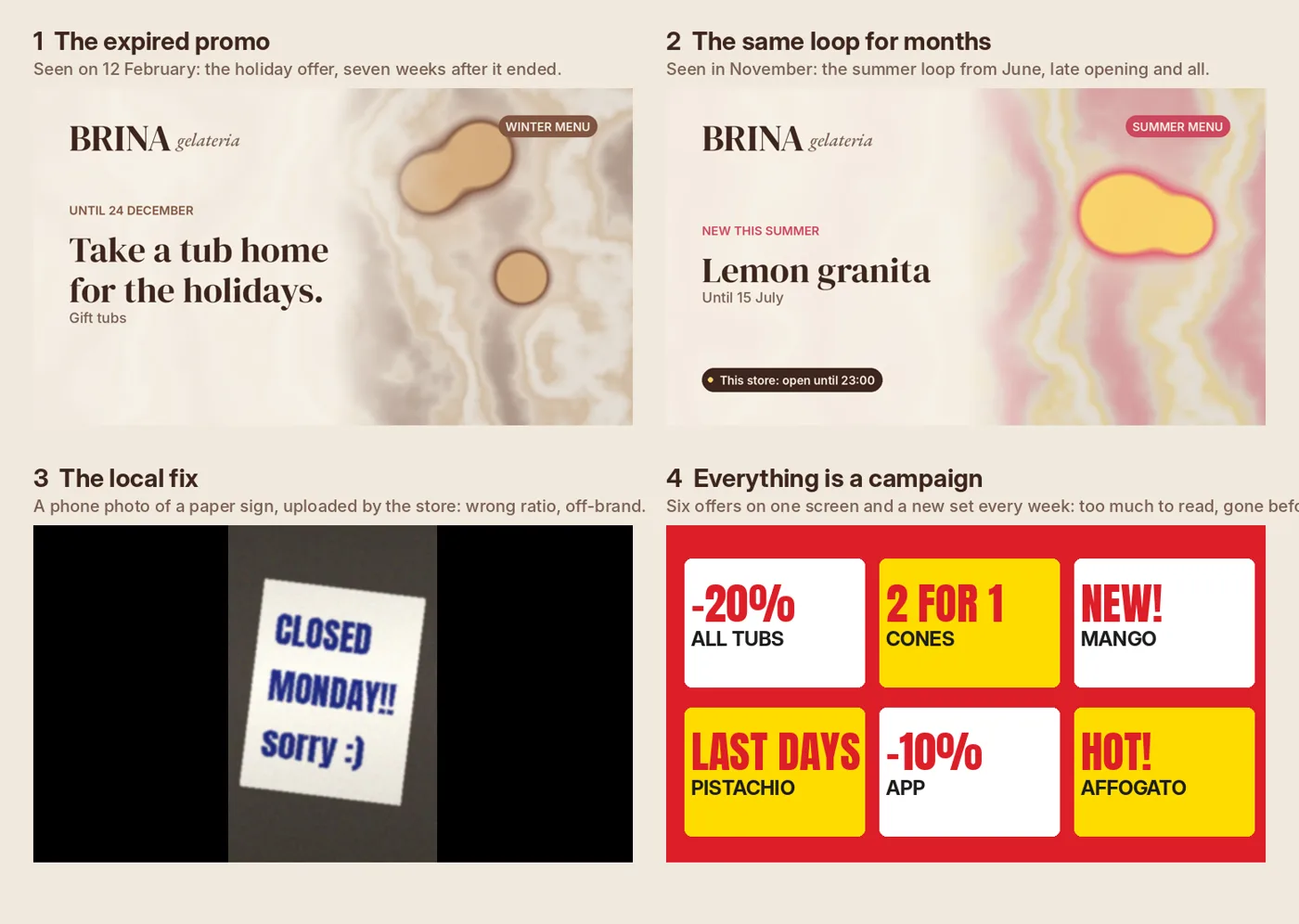
February, a gelato shop in a shopping street. The screen over the counter is still advertising holiday gift tubs, "until 24 December". Seven weeks late. In the branch across town, the summer loop has been running since June, late opening hours and all, and it is November. In a third branch, someone has fixed a closure notice by photographing a paper sign and uploading it: a sideways phone picture with black bars on both sides. And head office is about to send six new offers for next week, because last week's six did not seem to work.
Every one of these screens was set up with care. None of them has a system behind it.
The principle: a system beats a scramble
The four failures we see most often in real stores are all scheduling failures:
- Expired promotions still live. Last month's offer, Christmas in February. Nobody owns the end date, so nothing ends.
- The same loop for months. No base and no rhythm of refresh, so whatever was uploaded last stays up until people stop seeing it. We have seen stores run the same visual for a year or more.
- Random local uploads. A store fills a gap with a phone video or a photo of a poster: off-brand, the wrong ratio, never taken down.
- Everything is a campaign. Every screen changes every week, deadlines slip, quality drops, and then nothing changes at all.
There is a reason the second and the last of these hurt. In 1979 the psychologists John Cacioppo and Richard Petty tested what repetition does to a message. Hearing it a few times helped; hearing it too often wiped out the gain, as people got bored and started to argue with it. It was a lab study with students and spoken messages, but later work points the same way: a 2019 paper that reviewed 22 earlier studies found that in just over half of them liking peaked after about three exposures and then turned to annoyance, an annoyance that fades within a few weeks. A screen that never changes is on the wrong side of that curve. A screen that changes everything every week never gets onto it. And a 2026 field study of 237 in-store signage campaigns found screens lifted purchases of the featured product most when no other promotion was competing with them.
So the goal is not more content. It is updates that are predictable, light and hard to get wrong.
The mechanism: the Layer Model
Build every screen program from four layers. Each one has its own job, its own owner and its own pace.
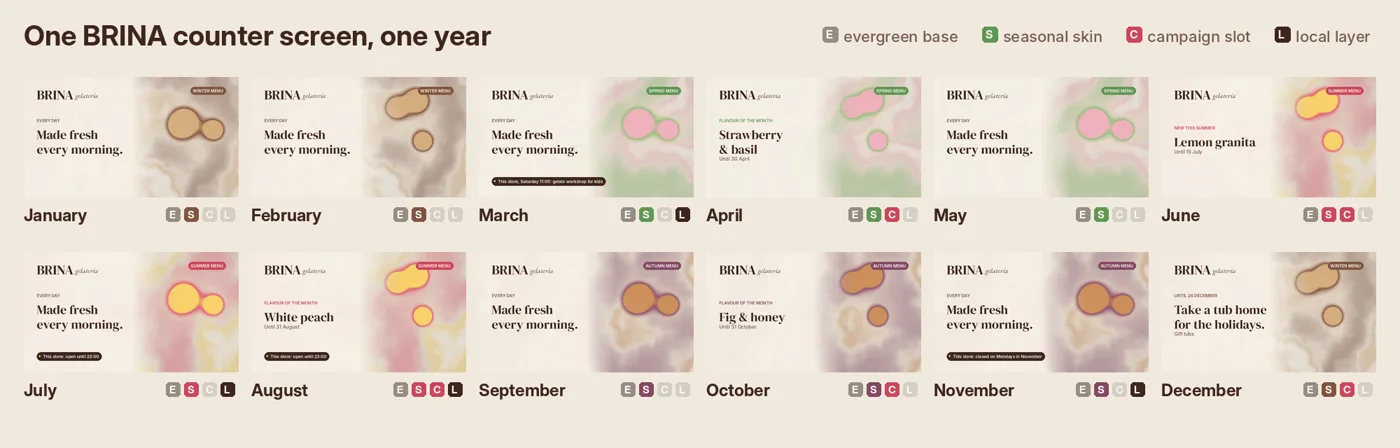
1. Evergreen base: always on, never empty. The brand at rest: the texture loops, the wordmark, one calm everyday line. For BRINA that is the marble swirl and "Made fresh every morning." It changes once or twice a year. Its whole job is to be there when nothing else is, so there is never a gap for a random upload to fill.
2. Seasonal skin: a skin, not a rebrand. Once a season, the same layout gets new colours and a seasonal detail. BRINA swaps two colours in the same marble and the same scoops: cocoa and caramel in winter, pistachio and blossom in spring, berry and lemon in summer, fig and chestnut in autumn. It keeps the motion grammar from Episode 5 and works in every ratio from Episode 11. It feels like a new chapter, not a new book.
3. Campaign slot: dated, limited, expiring. One or two campaigns a month, each in a slot, never the whole screen. Every campaign has a start and an end date before it goes live, and it runs only in the zones it was made for (Episode 6). When the slot is empty, the base line comes back on its own. BRINA's screen even prints the end date, "Until 31 October", so the store can see it too.
4. Local layer: template fields only. Stores need to say real things: holiday hours, a closure, a workshop on Saturday. They get a small tag in a fixed place and a few fields to fill, with an end date. They never redesign the screen.
The animation below runs one BRINA screen through a whole year in 24 seconds. Watch the lanes underneath: the base never stops, the skin changes four times, campaigns and local tags start and end on their dates, and between campaigns the everyday line comes back by itself.
The monthly ritual
The layers need a rhythm, and the rhythm can be dull. That is the point.
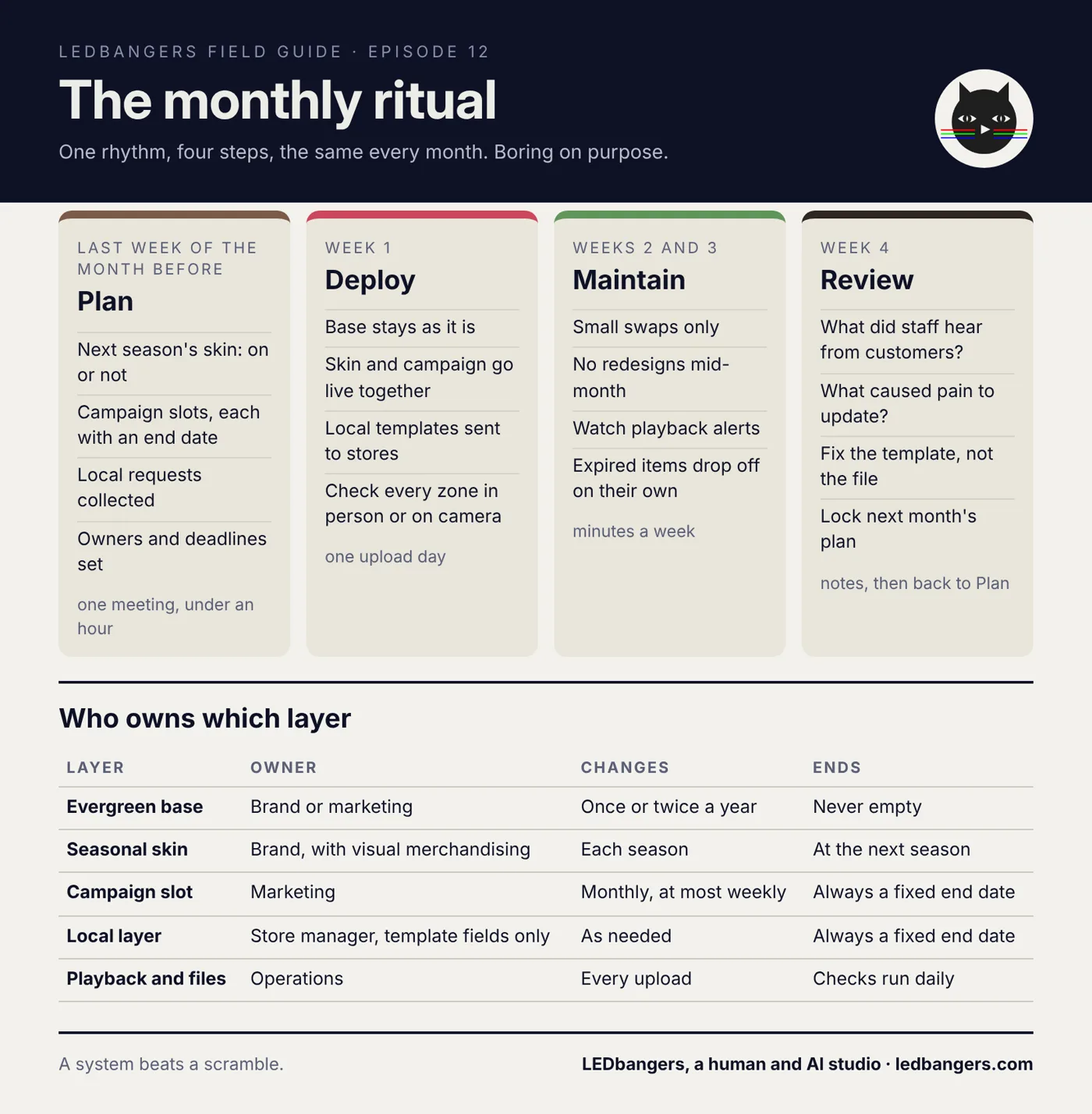
Plan, in the last week of the month before. Decide whether a new skin goes on, confirm the campaign slots with their end dates, collect local requests, assign owners.
Deploy, in week 1. The base stays. Skin and campaign go live together. Local templates go out to the stores. Someone checks every zone, in person or on camera.
Maintain, in weeks 2 and 3. Small swaps only, no redesigns. Watch the playback alerts. Expired items drop off on their own because the expiry lives in the player, not in someone's head.
Review, in week 4. What did staff hear from customers? What was painful to update? Fix the template, not the file. Then lock next month's plan.
And give every layer an owner. If one person must approve everything, you will always be late. If nobody approves anything, the network drifts.
Seeing it: a library built on a calendar
As in every episode: we do not have audience data and we do not fake it. We have production facts from our own work.
Our pharmacy library, the same one from Episodes 6 to 11, is being built as a subscription, not a one-off pack. A pharmacy downloads what fits its screens and swaps it over time. A subscription only renews if there is a reason to come back, and we decided early that the reason is the calendar.
So the library is organised on the same layers. Every piece is tagged on five axes: the screen form, the motif, the style, the motion, and the occasion. The occasions are the schedule: everyday pieces for the base; seasonal health for the skins, from winter colds to spring allergies to summer sun; public holidays and local festivals for the campaign slots. Operational content is the local layer: opening hours, closed for lunch, and a set for the Sunday duty rota, which we will only build once we have checked how the rota really works. The plan is monthly drops against that calendar. The structure came first, and the art follows it.
The deliverable: the Layer Model monthly plan
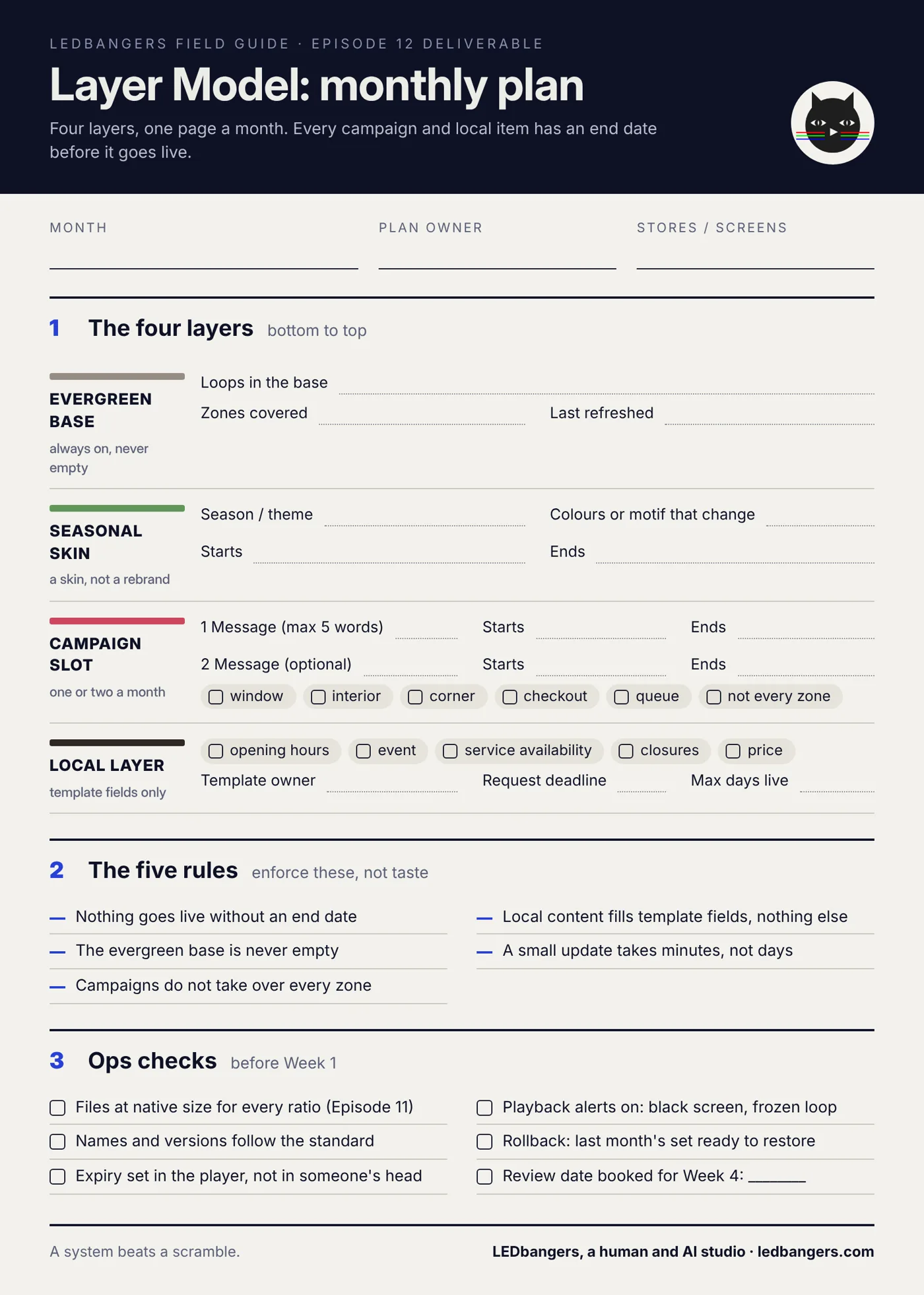
This episode's sheet is one page per month: the four layers with their dates and owners, the five rules, and the operations checks to run before Week 1.
The five rules, in one place:
- Nothing goes live without an end date.
- The evergreen base is never empty.
- Campaigns do not take over every zone.
- Local content fills template fields, nothing else.
- A small update takes minutes, not days.
The blank sheet is below. Fill it in during the planning week. If you want your base, skins and templates built so the monthly update really does take minutes, start a brief at ledbangers.com.
One thing to keep
Build a base that is never empty, change the skin with the season, give every campaign and local message an end date, and run the same small ritual every month.
Next episode
Episode 13, the season finale: rolling out to many stores. Templates, localisation, approvals and versioning, the governance that lets a network scale without turning the brand into a collage.
If you want the field guide as it ships, plus the deliverable from every episode, follow LEDbangers. If your screens are still running last season, start a brief at ledbangers.com.
LEDbangers is a human and AI studio making code-first motion for retail LED and OLED screens. This episode was researched and written with AI, built on our own research base and on interviews with Burcin Inan Ozel, who reviewed and edited every line. The figures are made in the studio the same way. Poma and Luma are the two cats who argue in the margins: instinct and structure, the two halves of every good screen.
Sources: John T. Cacioppo and Richard E. Petty, "Effects of Message Repetition and Position on Cognitive Response, Recall, and Persuasion", Journal of Personality and Social Psychology 37 (1979), doi 10.1037/0022-3514.37.1.97, abstract; Ann Kronrod and Joel Huber, "Ad wearout wearout", International Journal of Research in Marketing 36 (2019); Herhausen, de Jong and Grewal, In-Store Advertising with Digital Signage, Journal of Marketing 90(3) (2026).